Governed Robotic Intelligence System
Experience becomes knowledge.
Evidence decides truth.
Orion turns every mission, intervention, failure, replay, and debrief into traceable robotic memory — reviewed, reused, and evolved only when the evidence is strong enough. Weak evidence creates a question, never a silent truth.
The Problem
Robots are learning faster than their governance systems.
Modern robots generate telemetry, interventions, debriefs, simulations, and mission outcomes. In most systems that experience disappears into storage or becomes opaque model behavior with no evidence trail. The deeper risk isn’t that a robot fails — it’s that a weak pattern gets repeated, reused, or promoted before anyone sees the evidence behind it.
Was this learned from physical evidence or simulation?
Was it measured, derived, proxy-based, or operator-authored?
Does it apply to this robot, this fleet, or one operating regime?
What evidence contradicts it — and what must be validated first?
The Orion Approach
Governed intelligence from the first observation.
A mission run, manual session, safety stop, failure, recovery, or operator debrief becomes an ExperienceRecord — carrying intent, context, evidence quality, authority labels, and outcome. Orion compiles recurring records into reviewable patterns, exposes what they support and contradict, and routes weak or missing evidence into controlled validation instead of promotion.
Experience
Runtime activity persisted as a governed ExperienceRecord.
Evidence
Measured, derived, proxy, simulated, operator-authored — kept distinct.
Pattern
Deterministic clusters with support and contradiction counts.
Gaps
Missing validation surfaces as evidence gaps and RFEs.
Candidate
Reviewable, auditable — never an automatic behavior change.
Knowledge
Reused only inside its validated scope and authority ceiling.
The compiler produces hypotheses, scorecards, and next actions. It does not apply trim, promote laws, or mutate mission policy.
The Platform
A physical reference robot for the governance loop.
Orion is validated against a real, low-speed indoor rover — not just simulation. The platform is the ground truth where evidence is measured, interventions happen, and edge-local safety stays authoritative.
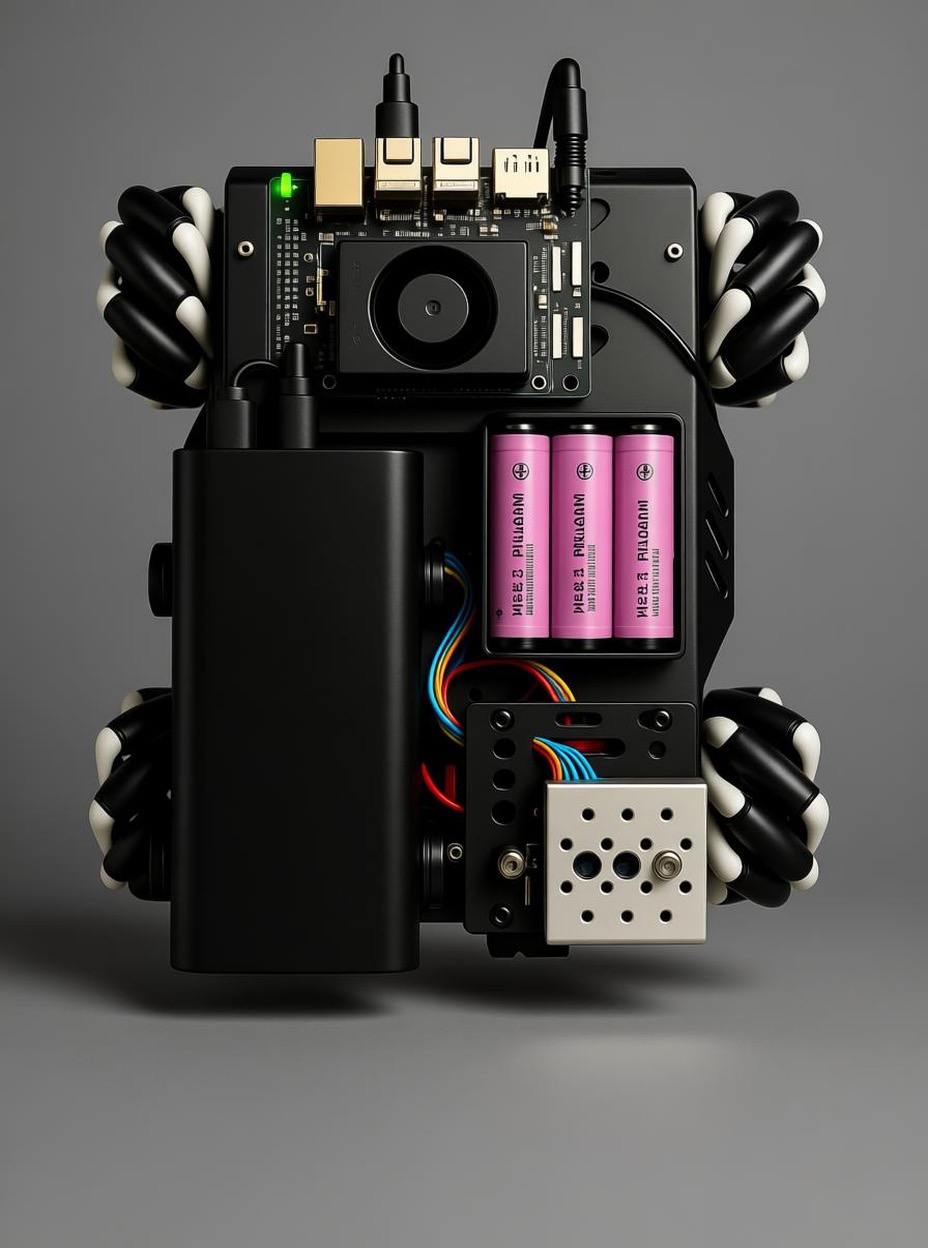
Where simulation meets physical evidence.
A holonomic mecanum-wheel rover carrying onboard compute, sensing, and managed power. Every run it performs becomes an ExperienceRecord with measured evidence — the raw material the Knowledge Compiler reasons over.
Because the hardware is the reference path, Orion can keep physical evidence and simulated evidence cleanly separate, and prove that edge-local stop, firmware timeout, and operator STOP remain authoritative when the central layer is unavailable.
Core Capabilities
Built so weak evidence is visible — not buried.
Governed Knowledge Compilation
Repeated ExperienceRecords compile into reviewable pattern envelopes with support counts, contradiction counts, evidence gaps, transferability labels, and promotion readiness.
Implemented: read-only pattern projection & scorecards. Governed compile actions are design intent.
Evidence-Aware Learning
Measured, derived, proxy, simulated, operator-authored, and unavailable evidence stay separate instead of collapsing into a single confidence number.
Implemented: across records, graph scorecards, token confidence, and Fabric semantics.
Traceable Experience Graphs
Episodes link to robots, missions, mechanisms, components, regimes, evidence authority, tokens, artifacts, patterns, and candidates.
Implemented: deterministic read-only projection, pattern membership, explanation APIs.
Traceable Robotic Memory
A failure becomes a searchable learning artifact — intent, evidence, outcome, links, privacy controls, and next-action guidance.
Implemented: schema, persistence, capture, classification, review, export, redaction.
Reusable Operational Knowledge
Graph links, laws, lifecycle state, review state, provenance, dataset lineage, and versioned artifacts — preserved with governance context.
Implemented: Fabric Operations and persistence surfaces.
Human Oversight & Governance
Mission intent, authority modes, evidence contracts, approval, launch, monitoring, and debrief stay explicit. Fabric can be disabled, observe-only, advisory, guarded, or directive.
Implemented: Mission Studio semantics and mission-contract code.
Inside the Product
Not a concept deck. A running system.
The governance surfaces described above are live in the Orion portal today — service health, mission control, cognitive posture, and a Fabric Govern deck where staged knowledge is reviewed before it can ever be accepted.
Product Gallery
The governance surfaces, in the portal.

Live system & operating posture
Service health across MQTT, Brain, DB, gRPC, and fleet, with Ghost Mode posture profiles and cognitive tuning.

Bounded experience review
Records stay read-only while lifecycle state, evidence quality, authority, scope, and linked context remain visible for review.

Fabric Guard & launch gate
Runtime protection sits inside the launch gate before explicit approval — trigger fields, world model, and posture all explicit.

Compute & solver health
Quantum and classical solve counts, request load, and rolling p95 latency over the live request window.

Operations summary, light theme
The same evidence-first operations view, available in a light theme for bright control rooms.
Portal screens shown for illustration. Live metrics depend on connected robots and an active session.
Why Orion Is Different
Not a robot. Not a black-box agent. A governed intelligence layer.
Orion does not treat one run as truth, simulation as physical proof, or operator claims as measured evidence. It will not let candidate knowledge quietly rewrite accepted world knowledge. Instead it builds a visible chain — and that chain is the product.
- Robot experience is governed memory, not disposable logs.
- Observed data, hypotheses, candidates, and accepted knowledge stay distinct.
- Evidence quality is a product surface, not hidden backend scoring.
- Weak evidence creates gaps, RFEs, or guarded posture — never silent truth.
- Every pattern points back to supporting and contradicting records.
- Central intelligence and local safety are cleanly divided.
Use Cases
For teams where autonomy has to stay traceable.
Autonomous Inspection
Supervise bounded inspection missions where robots collect telemetry, meet changing conditions, and need auditable debriefs.
Preserve what happened, what was trusted, what was uncertain, and what to test before expanding autonomy.
Research Robotics
An evidence-aware control and learning platform for experiments, benchmarks, replay review, and mission comparisons.
Separate physical evidence from simulation and avoid overclaiming from weak data.
Industrial Monitoring
Supervised patrol, environmental snapshot, anomaly-observation, and evidence-collection in controlled spaces.
Mission history, guard decisions, and physical-token evidence instead of isolated logs.
Mission Knowledge Reuse
Carry lessons forward through ExperienceRecords, Fabric artifacts, evidence gaps, and governed candidates.
Reuse knowledge without erasing the robot-specific vs. fleet-candidate boundary.
Enterprise AI Governance
Use Orion’s evidence, traceability, authority, and review model as a governance layer for embodied AI.
Inspect how physical evidence, operator input, simulation, and hypotheses move toward use.
Market-positioning inference from the architecture, not a validated deployment claim.
Long-Duration Autonomy
A foundation for systems that accumulate understanding across many bounded missions and evolving hardware.
Supports controlled knowledge evolution, decay/retirement concepts, and review gates.
v1 validated envelope is bounded and simulator-first; long-duration autonomy is a direction.
Architecture
From embodied activity to governed knowledge.
Platform Control
Portal, API, central runtime, Mission Studio, Knowledge Fabric, Experience Fabric, RFE workflows, physical-token governance, persistence, auth, and observability.
Edge Execution
Robot firmware, ROS bridge, MQTT bridge, local sensor processing, mission execution, motor timeout, reflex stop behavior, and telemetry publication.
Mission & Knowledge
The contract layer binding mission intent, evidence collection, authority, Fabric governance, physical tokens, debriefs, review artifacts, and reusable knowledge.
Critical boundary — The graph and compiler never directly change robot authority, apply trim, promote laws, or mutate mission policy. Edge-local stop, firmware timeout, and operator STOP stay authoritative when the central layer is unavailable. Persistence failure degrades to missing insight, not unsafe behavior.
Trust, Evidence & Governance
Weak evidence should create a question, not a truth.
- One experience can become evidence — never accepted truth.
- Simulation supports planning, not physical promotion by itself.
- Operator debriefs become structured claims requiring evidence.
- Proxy-only evidence justifies caution, not confirmation.
- Contradictions stay visible for investigation.
- Candidate actions require explicit, auditable review.
- Mission runtime cannot exceed the accepted authority ceiling.
- Local stop behavior stays authoritative when central knowledge is unavailable.
Every claim can carry the context that makes it reviewable:
- Which robot, mission, and run produced it.
- Which component, mechanism, and operating regime it concerns.
- Whether the evidence was physical or simulated.
- Whether it was measured, derived, proxy, estimated, or operator-authored.
- Which records support it and which contradict it.
- What validation is missing — and whether it is reviewable, blocked, or not ready.
Vision
Robots should not only react. They should accumulate governed understanding.
The next generation of robotic systems needs more than better controllers and bigger models. It needs a memory that knows what was tried, what was measured, what was inferred, what failed, what contradicted prior knowledge, and what must be validated before reuse. Orion is robotic intelligence that compounds — but never forgets its evidence.
Get Started
Build robots that learn with evidence, scope, and review.
Orion is for teams building serious robotic systems in environments where autonomy must stay traceable, evidence-aware, and governable.