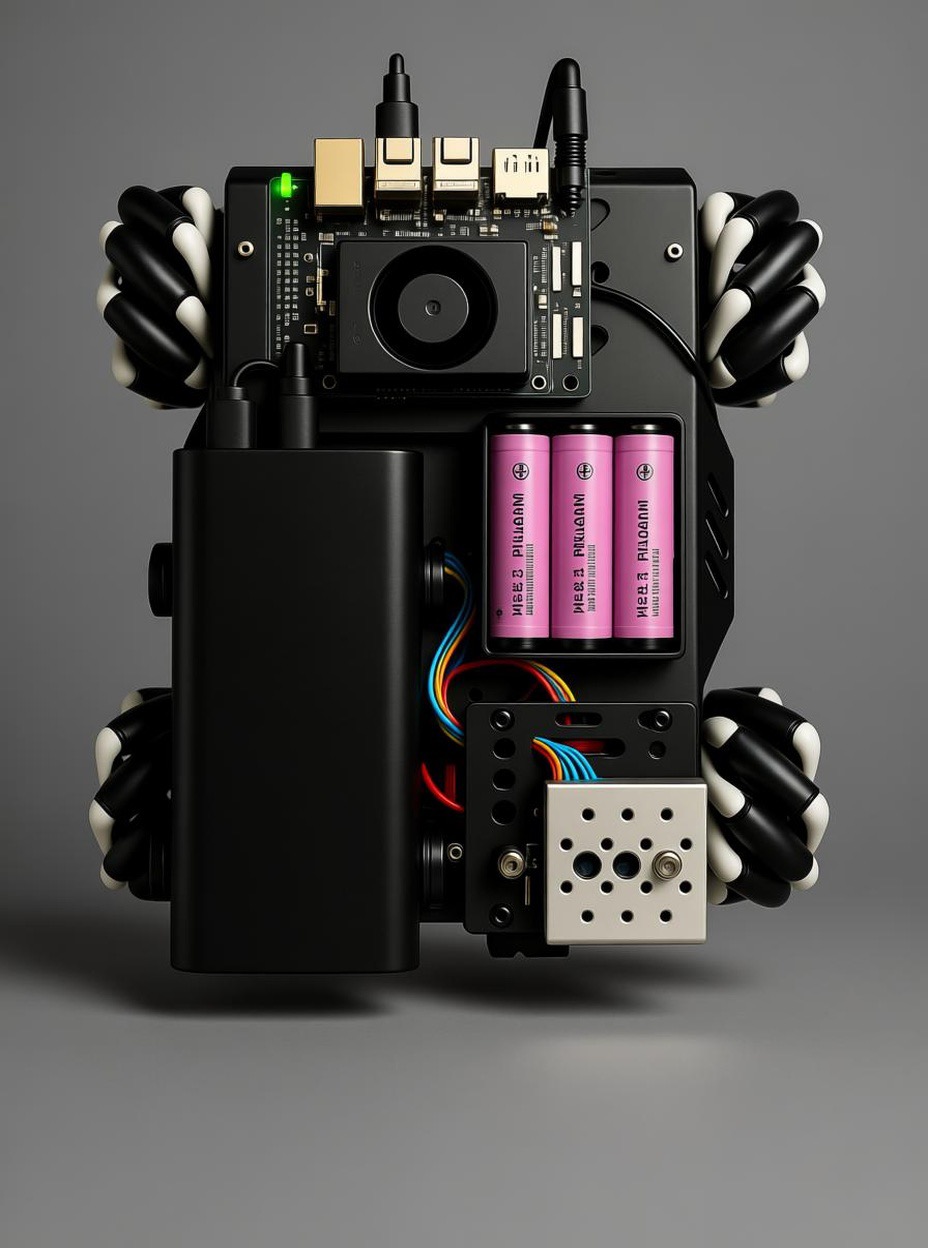
Turn robot telemetry into inspectable knowledge, safer missions, and measurable improvement.
Orion helps robotics teams move beyond fixed heuristics and black-box autonomy. It keeps reflex safety local at the robot, builds shared memory in a live Knowledge Fabric, and gives operators a governed path from plain-language mission intent to reviewed deployment.
Evidence note: the efficiency metrics on this page come from a documented-hardware simulator execution aligned to Orion’s current rover baseline. The source report is suitable for protocol review and relative comparison, and it is explicitly not presented as a substitute for physical validation.
Hazard-entry reduction in the documented rover promotion run generated on March 22, 2026.
Reduction in maximum wheel slip while retaining full route completion.
Mean-speed improvement versus the frozen baseline cohort in the same study.
Explicit models, laws, and provenance instead of opaque adaptation.
Human review, promotion gates, and staged deployment built into the loop.
Reflex safety and stop behavior remain local at the robot.
Performance claims stay attached to documented case-study evidence.
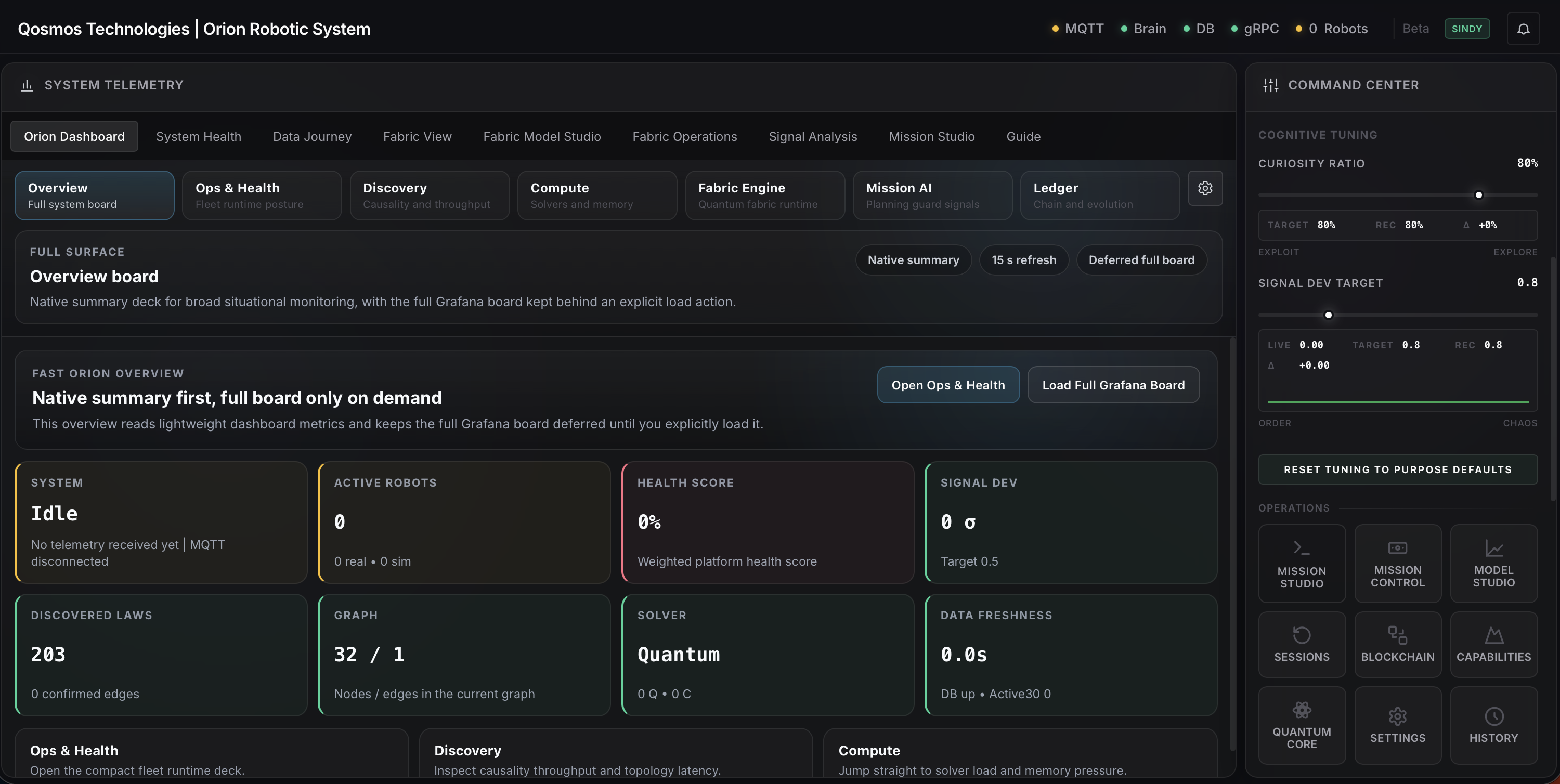
Dashboard overview / fleet posture, telemetry health, and mission readiness in one operator surface.
A mission-aware robotic brain for teams that need learning without opacity.
Orion combines telemetry, discovery, world modeling, mission orchestration, and operator review in one operating surface. Instead of treating robot experience as disposable logs, it turns repeated evidence into explicit knowledge that teams can inspect, challenge, and reuse.
One place to watch system state, mission posture, and learning progress.
The Orion dashboard brings together telemetry health, discovery activity, compute state, mission surfaces, and purpose-aware operational tuning. That makes the fleet manageable as one cognitive system instead of a set of disconnected tools.
- Observe the active fleet, runtime posture, data freshness, and discovery volume.
- Keep Mission Studio, Fabric access, and operational controls close to the evidence that drives them.
- Use one operator-facing environment to move from monitoring to governed action.

Data journey / from sensing and ingestion to feedback, evolution, and federation.
From sensing to shared knowledge, Orion keeps the whole loop readable.
Most systems hide the path from observation to adaptation. Orion makes it explicit so teams can understand how telemetry becomes a world model, where confidence comes from, and what changed before a mission plan is affected.
Data Journey
Track the path from live sensing through ingestion, processing, knowledge feedback, evolution, and federation. Orion does not hide the learning pipeline. It operationalizes it.
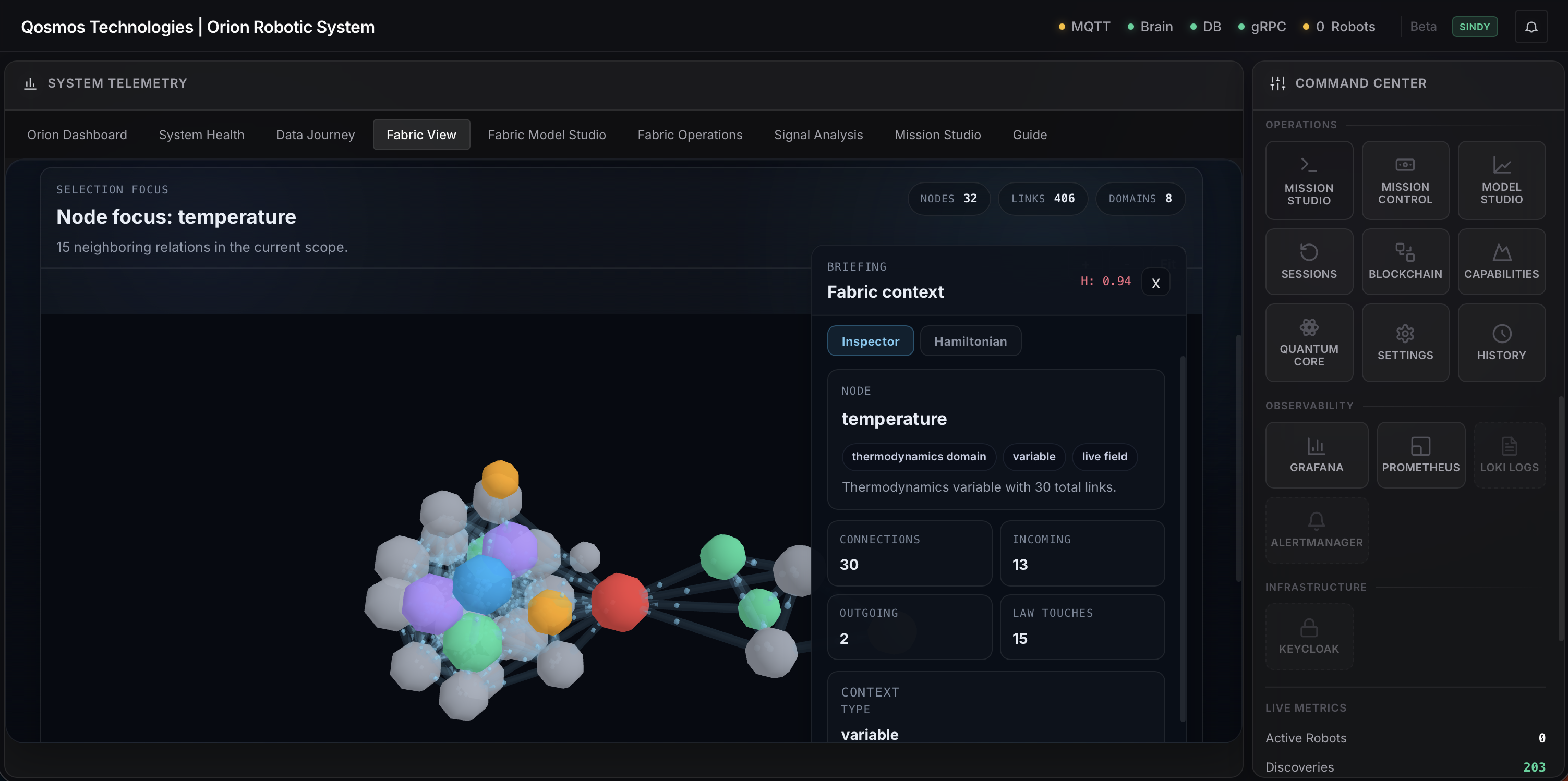
Fabric view / graph structure, live topology, and knowledge relationships kept inspectable.
Shared memory that stays inspectable under real operating conditions.
The Knowledge Fabric acts as Orion’s explicit memory layer, where graph structure, law candidates, model scope, and live topology remain inspectable instead of disappearing into model internals.
Readable world state, not hidden adaptation.
Orion keeps the fleet’s current understanding visible to operators and engineers so decisions can be challenged, explained, and improved over time.
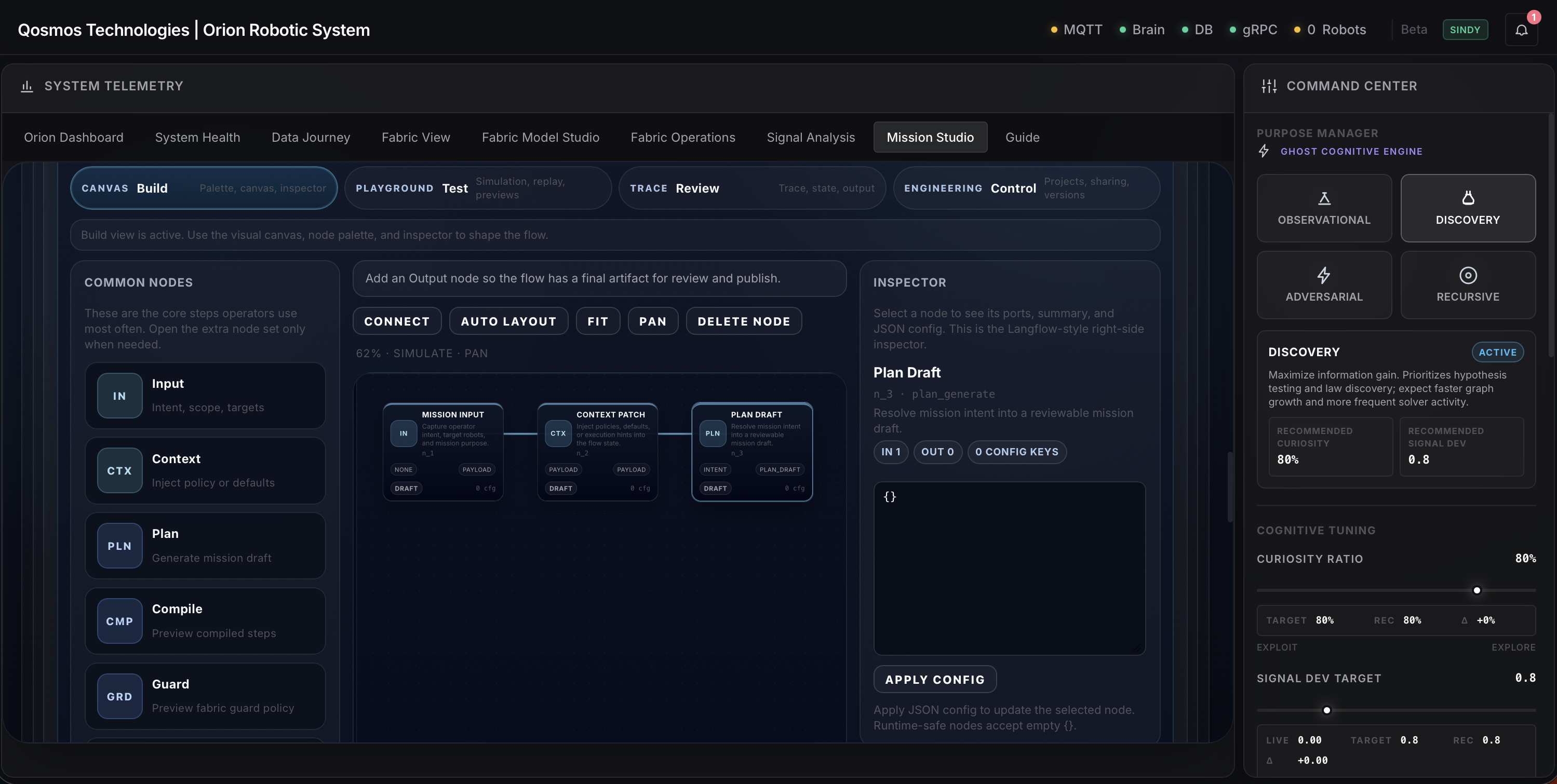
Mission Studio / mission drafting, review, simulation, and governed dispatch in one flow.
Write the mission in plain language. Keep approval and guardrails explicit.
Mission Studio is Orion’s operator control plane. Teams define mission intent, safety limits, and success criteria in human language, then review the translated plan, readiness context, and Fabric protection before anything moves into execution.
- Choose fleet or individual robot scope.
- Resolve plain-language intent into a structured mission draft.
- Preview fabric protection and mission gate state: go, guarded, or hold.
- Approve and dispatch only after the evidence is understandable.
Orion keeps learned relationships explicit enough for engineers and operators to interrogate.
The platform does not stop at surfacing a risk score. It preserves candidate laws, coefficients, dependency structure, provenance, and governance state so teams can ask what the system thinks, why it thinks it, and whether that belief should influence a mission yet.
Discovery that can still be governed.
That is how Orion turns learning into a deployable system component instead of a black box floating outside operations.
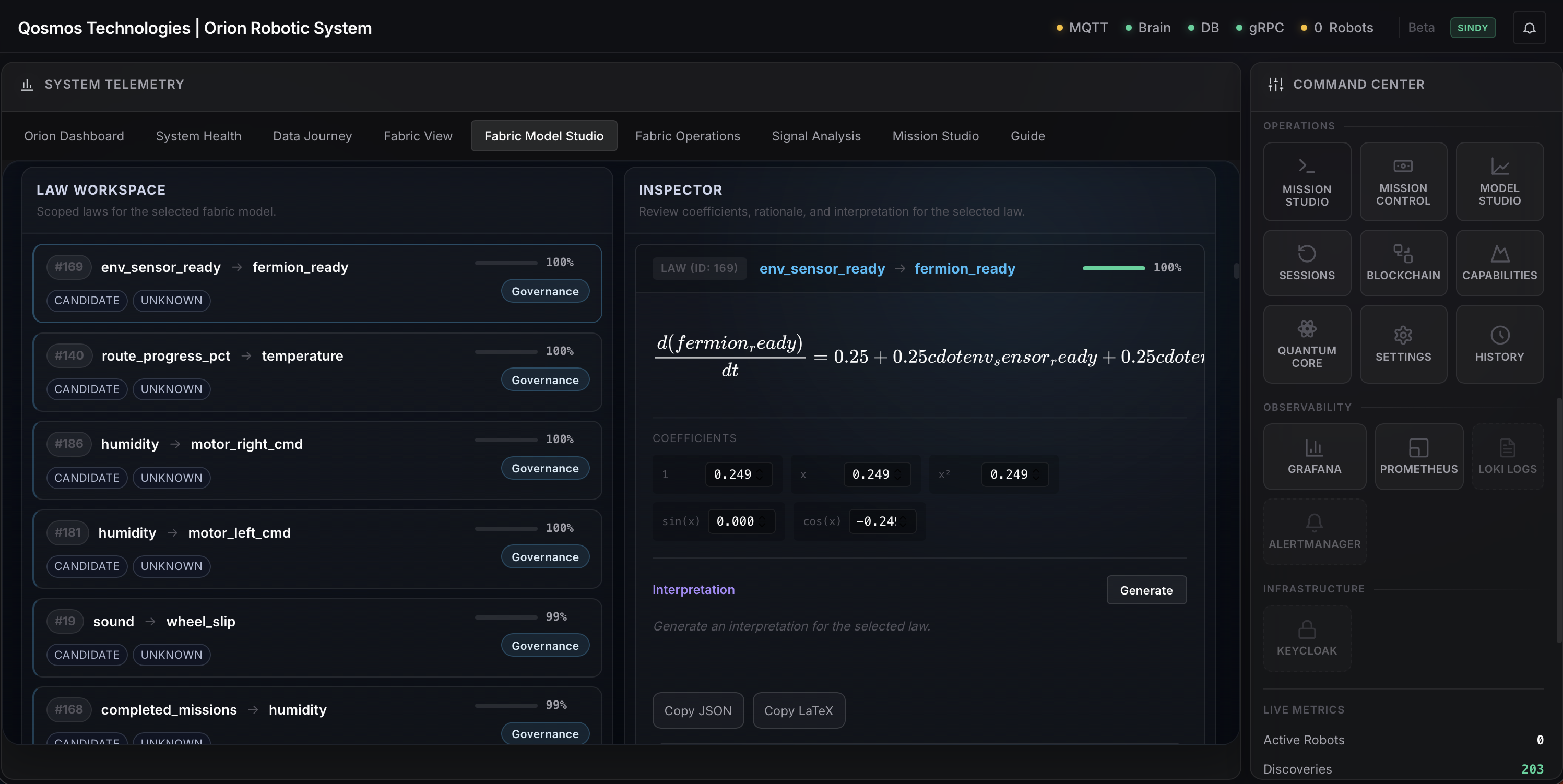
Law inspector / coefficients, confidence, and governance state shown as explicit objects.
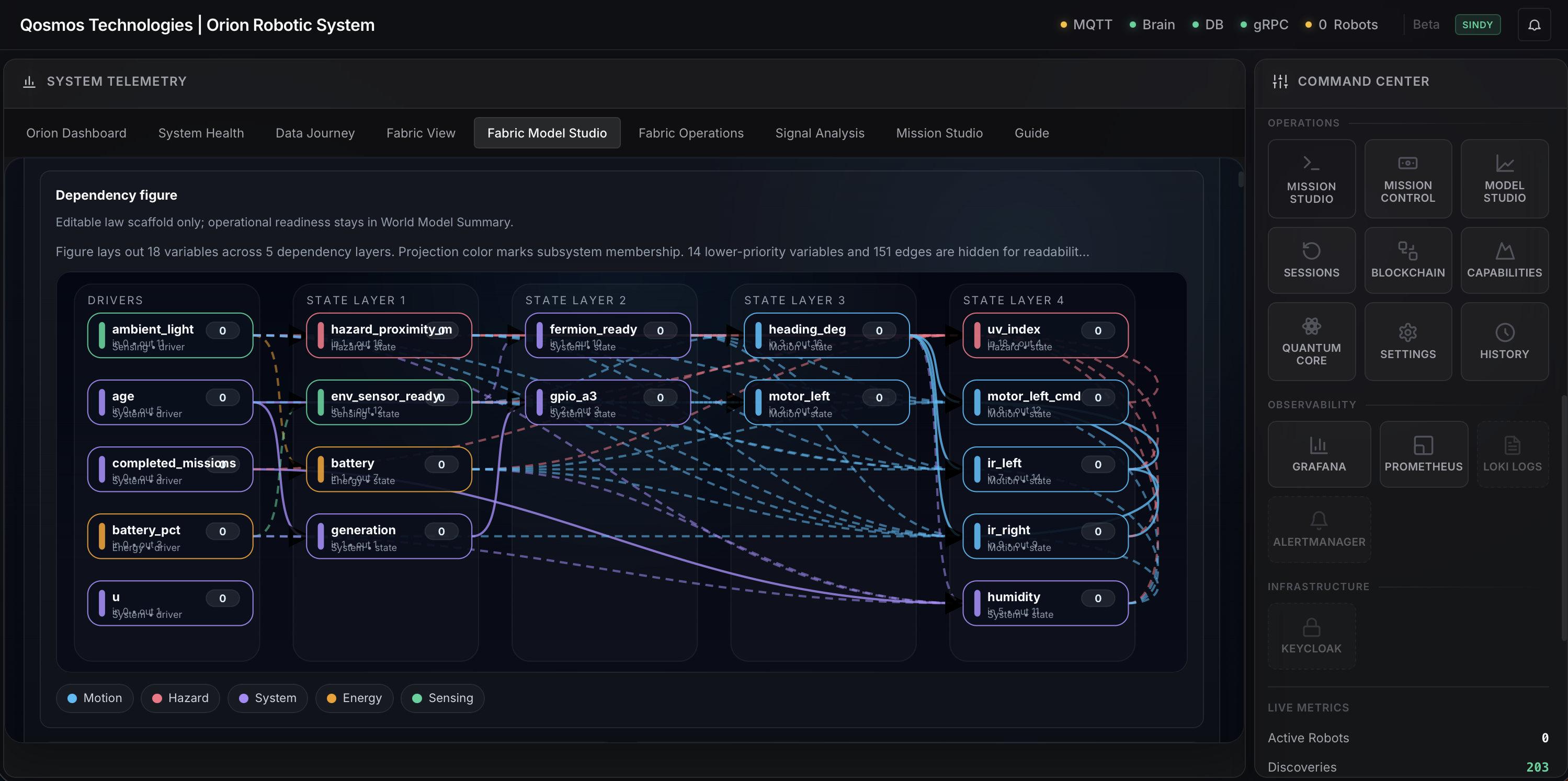
Dependency view / how sensing, hazard, energy, and motion variables are structurally linked.
Safe learning starts with bounded autonomy, layered control, and disciplined review.
The Orion rover case study is intentionally conservative. The protocol keeps emergency stop, timeout stop, malformed-command rejection, local obstacle reflex stop, and manual override on the robot. Orion improves when to slow down, when to hold, when to rescan, and when telemetry quality is too weak for trusted motion.
Reflexes stay at the edge.
Orion is not the first and only layer preventing collision. The rover protocol keeps local stop behavior and fail-safe motion controls below the learning layer, which is essential for real bounded deployments.
Start with practical safety relationships.
The first useful laws are not vague notions of autonomy. Orion focuses on relationships such as turn bias to yaw rate, forward command to stop risk, and proximity asymmetry to corridor drift.
Promote with evidence, not instinct.
The rover workflow stages commissioning, observational baseline, controlled discovery, fabric-guided slow autonomy, and repeatability under environment variation before anything earns guarded-pilot status.
Evidence from the Orion rover safe-training case study.
In the March 22, 2026 documented-hardware simulator execution, Orion completed the full staged safety protocol, including 10 discovery generations and 55.0 minutes of simulated runtime. The selected candidate reduced hazard exposure, wheel slip, and yaw instability while preserving route completion strongly enough to earn the governance decision promote_to_guarded_pilot.
68.04%
Hazard-entry reduction versus the frozen baseline cohort, without sacrificing route completion.
Safer behavior, not slower avoidance.
Orion did not achieve the result by freezing the rover into inactivity. Wheel slip fell, peak yaw fell, mean speed increased, and final progress stayed at 100%.
The section below makes the improvement legible as operational evidence: each metric shows the baseline value, the promoted candidate value, and the direction of change.
727.5 to 232.5
Down 68.04% versus the frozen baseline cohort.
0.699 to 0.356
Down 49.17% while the rover still finished the route.
90.6 to 67.4 deg/s
Down 25.59% for calmer motion under the same protocol.
0.257 to 0.348 m/s
Up 35.57% with full progress retained at 100%.
What the evidence says
Relative to the frozen baseline cohort, hazard entries moved from 727.5 to 232.5, maximum wheel slip moved from 0.699 to 0.356, and peak yaw rate moved from 90.6 to 67.4 deg/s. Mean speed improved from 0.257 m/s to 0.348 m/s while final progress stayed at 100%.
That matters because Orion is not only claiming safer behavior. It is showing safer behavior with preserved throughput, explicit governance thresholds, and visible pair-level variability instead of hiding the hard parts behind an aggregate win.
Safety improved without sacrificing mission completion.
The headline result combines 68.04% hazard-entry reduction, 49.17% wheel-slip reduction, 25.59% lower peak yaw rate, 35.57% higher mean speed, and 100.00% final progress retention. Orion’s promotion logic makes those tradeoffs explicit instead of forcing teams to guess whether safety was bought by freezing the rover too often.
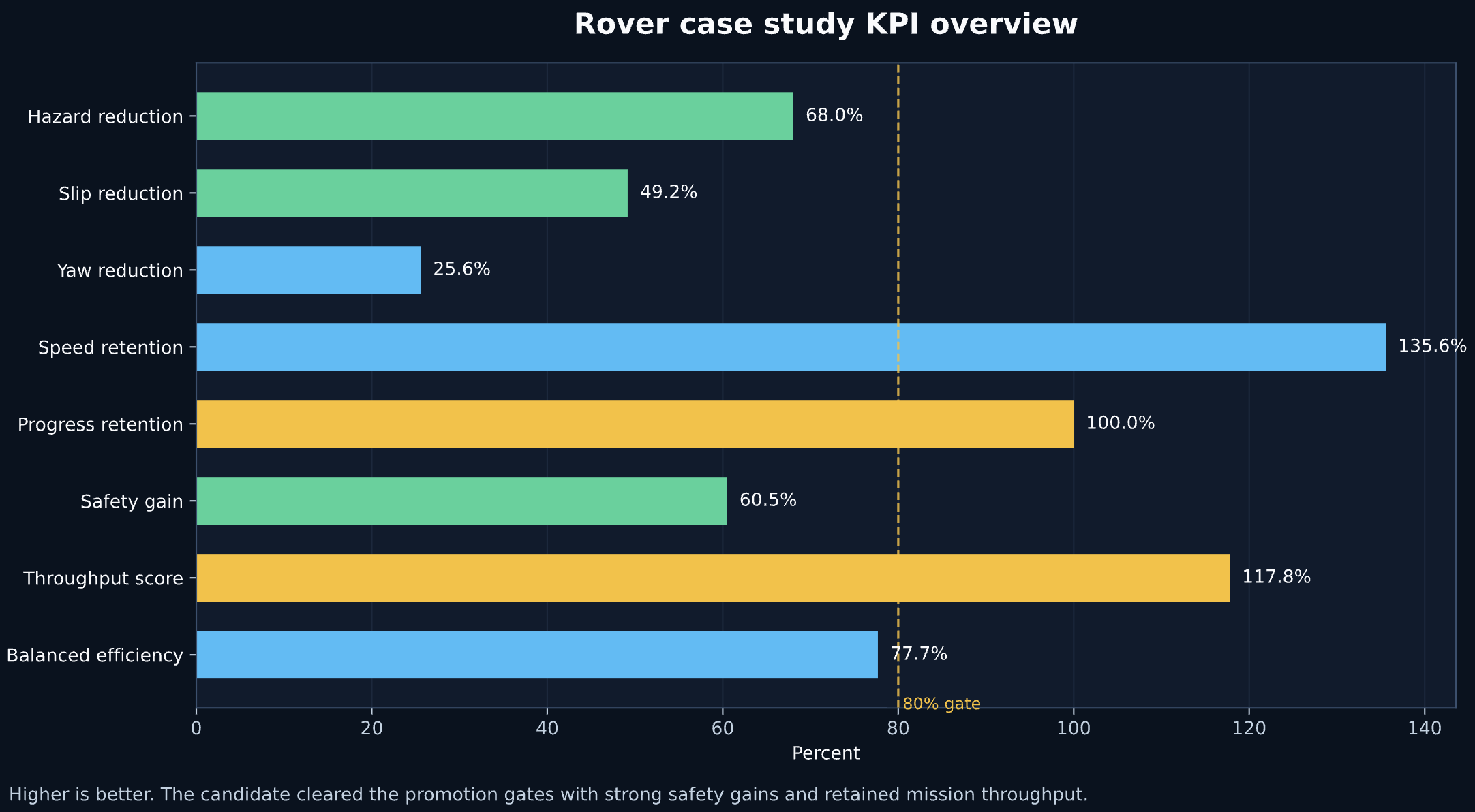
KPI Overview
This figure summarizes the full case-study outcome in one place: fewer hazard entries, lower slip, calmer yaw behavior, stronger speed retention, and unchanged route completion.
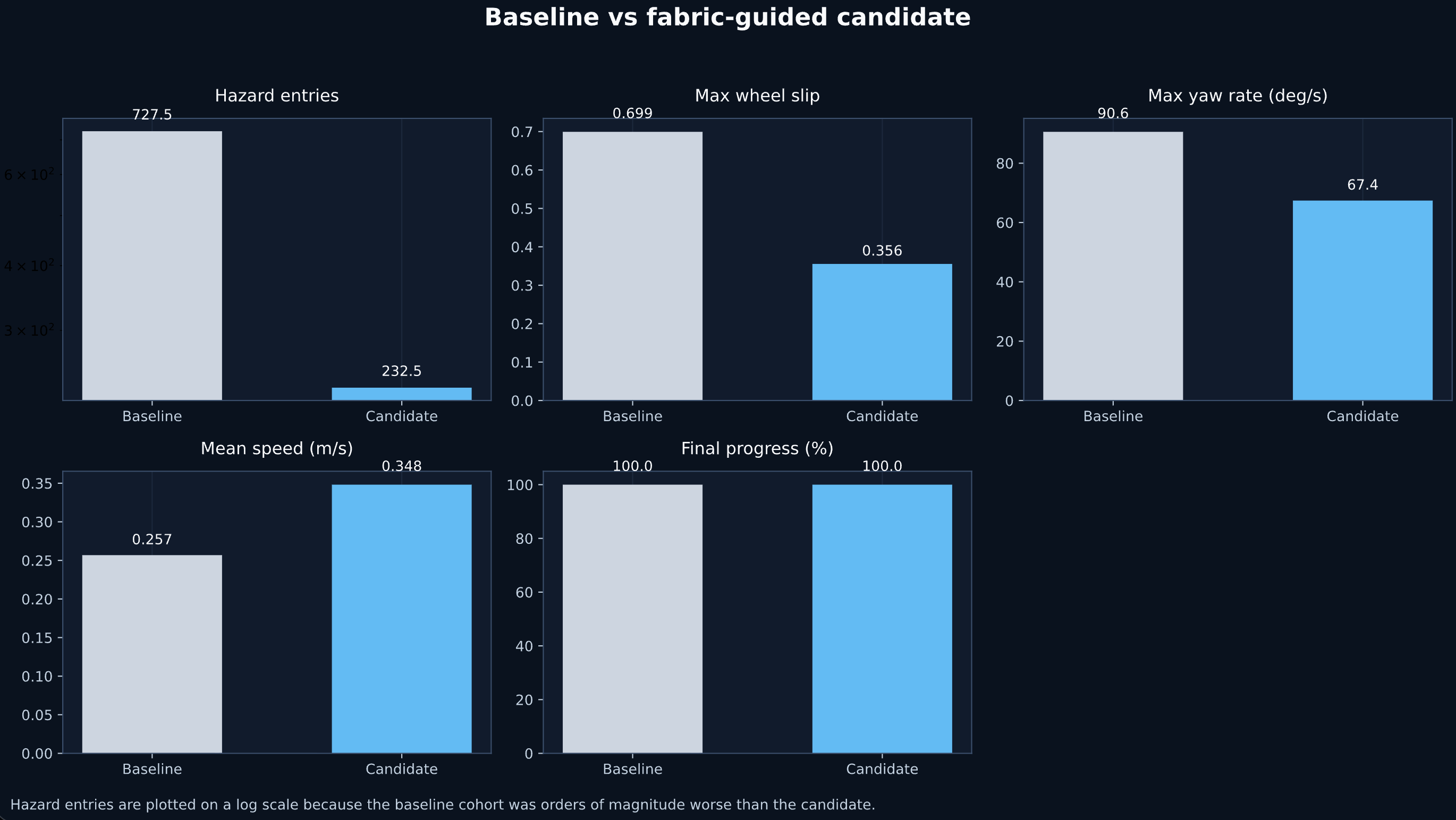
Baseline vs Candidate
The comparison makes the operational delta concrete: hazard entries fell from 727.5 to 232.5, max wheel slip dropped from 0.699 to 0.356, and peak yaw moved from 90.6 to 67.4 deg/s.
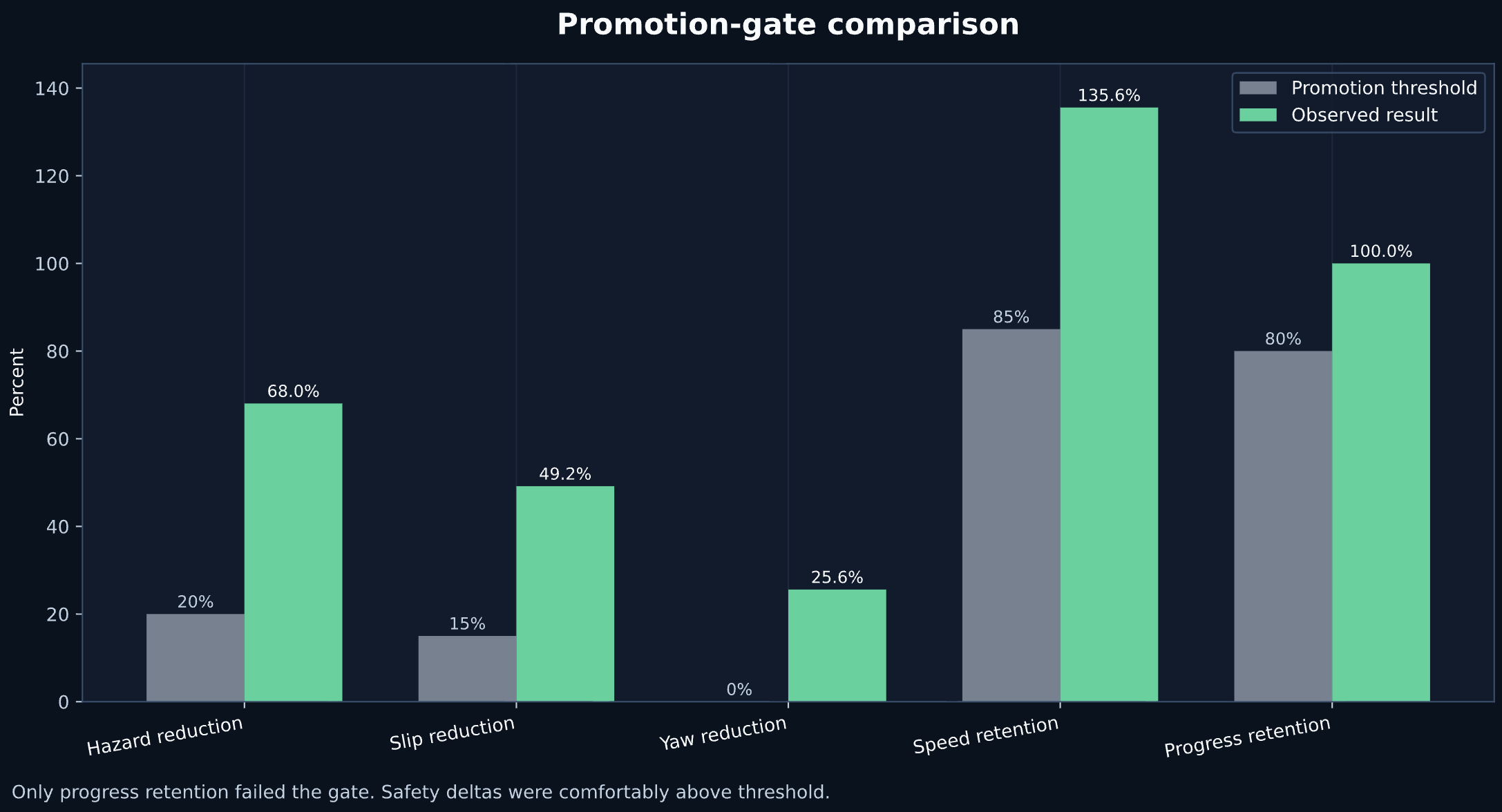
Promotion Gate
The governance gate shows how the candidate cleared the required safety, stability, and throughput thresholds before earning the March 22, 2026 decision to promote to guarded pilot.
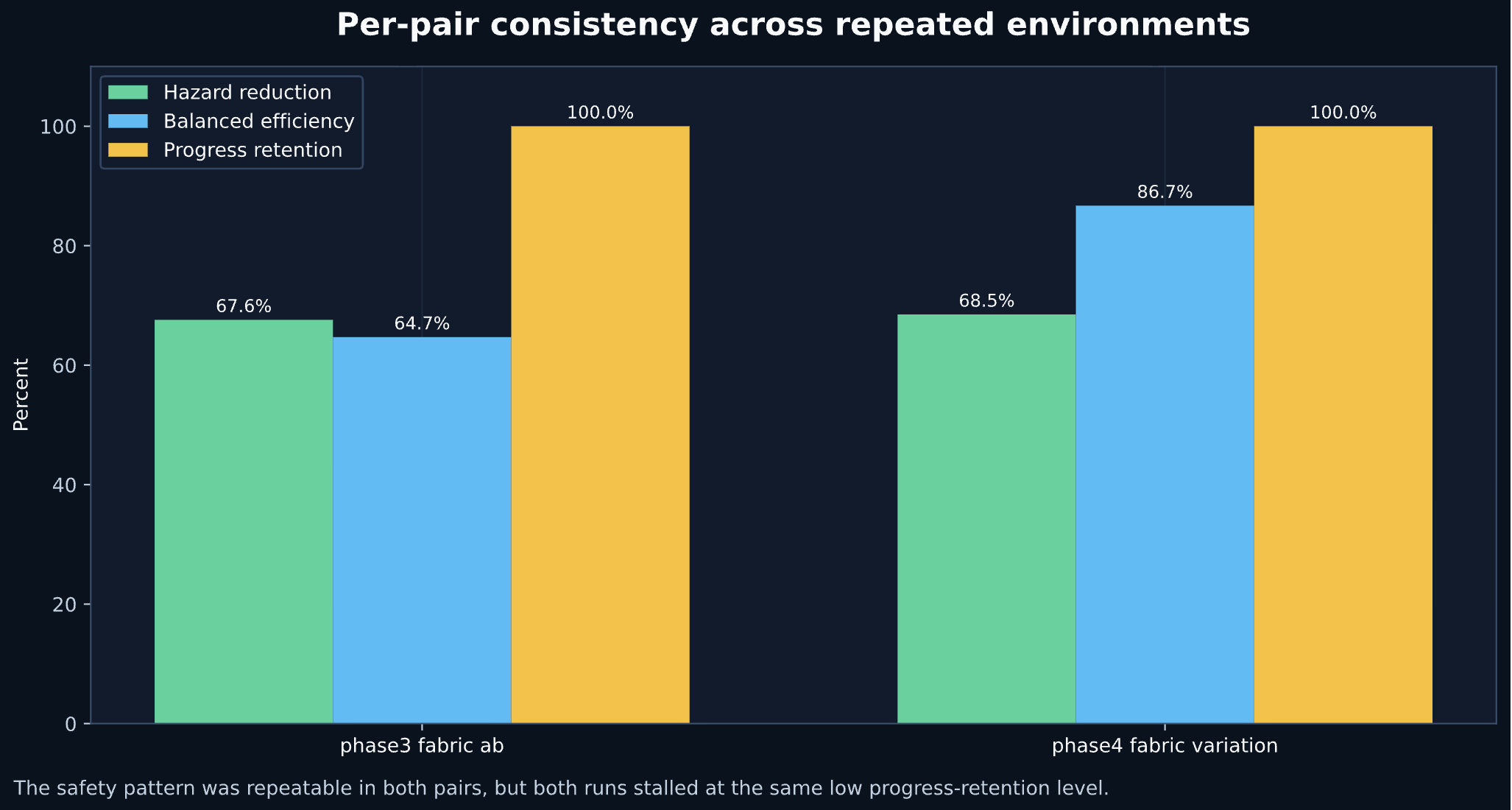
Pair Consistency
Orion keeps repeatability visible. The pair-level view shows that one A/B pairing was rejected while the environment-variation pairing cleared the guarded-pilot decision, which is exactly why the platform preserves traceable evidence instead of relying on a single average.
Use Orion when your robotics stack needs learning, governance, and operator trust at the same time.
Orion is built for teams that want cumulative robotic learning without giving up reviewability, deployment discipline, or engineering control. For demos, pilot programs, or technical evaluation conversations, contact us directly.
 Qosmos Technologies