World Modeling for Advanced Robotics
A more enduring form of robotic intelligence.
Orion transforms sensing, mission activity, and embodied interaction into a structured world model that teams can inspect, trust, and refine.
Built for advanced robotics programs that value scientific rigor, operator clarity, and cumulative learning, Orion turns robotic experience into explicit knowledge that remains useful across time, missions, and systems.
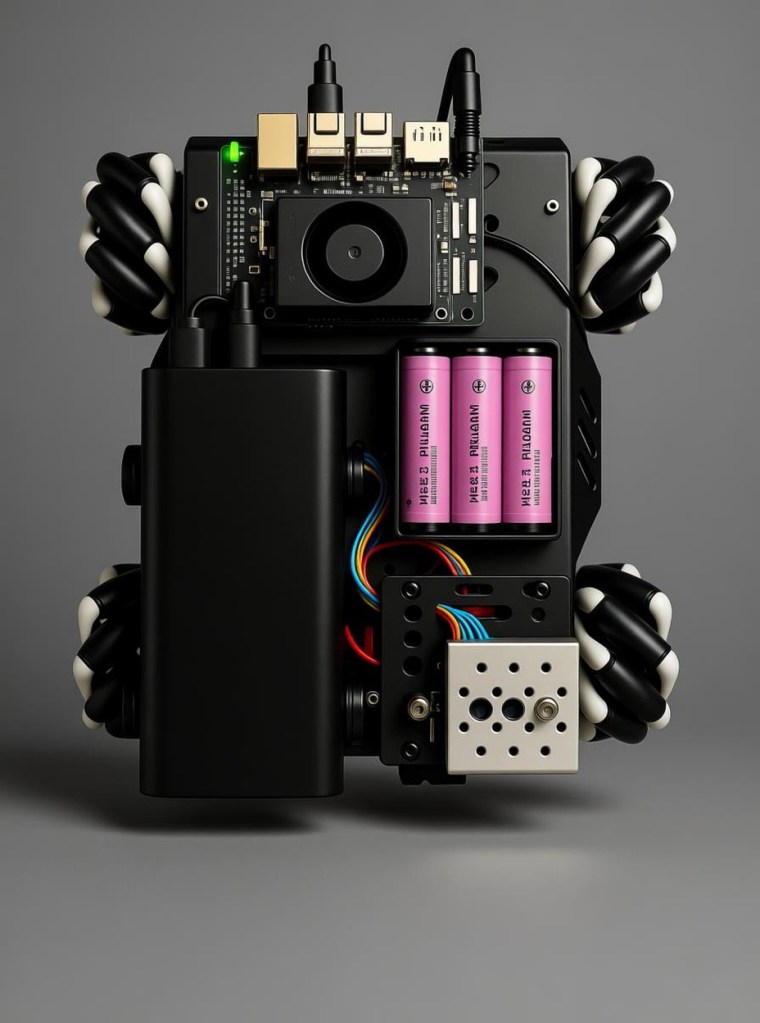
Knowledge Fabric
A persistent world model built from relationships, laws, confidence, and provenance.
Causal Intelligence
Inference guided by dependency, temporal structure, contradiction, and revision.
Guided Discovery
Purpose modes, mission design, and evolution loops that reduce uncertainty intentionally.
Why Orion Is Different
Most systems retain data. Orion preserves a governed model of what the system has learned.
Orion does not treat telemetry as a disposable stream. It turns robotic experience into explicit knowledge that can be inspected, challenged, promoted, revised, and reused across runs, robots, and environments.
That is the difference between system memory and system understanding. Orion keeps evidence, belief, and mission intent connected, so learning becomes legible enough to govern instead of simply accumulating in logs.
The Knowledge Fabric
A world model that remains visible, inspectable, and reusable.
At the center of Orion is the Knowledge Fabric: a persistent world model that stores relationships, equations, graph links, rationale, metadata, and provenance as first-class knowledge. Orion is designed to preserve what the system has discovered in a form that people can read, question, govern, and build upon.
The distinction between sessions and fabric models is critical. Sessions record what happened across telemetry, events, and missions. Fabric models express what the system currently believes and is prepared to use. Together they provide replayable evidence for the past and a governed theory layer for the future.
Because the Fabric is explicit and versioned, knowledge can be compared, promoted, refined, exported, transferred, and reused across runs, robots, and environments instead of being rediscovered from scratch. Edges, equations, and hypotheses remain linked to provenance, audit context, and operator review.
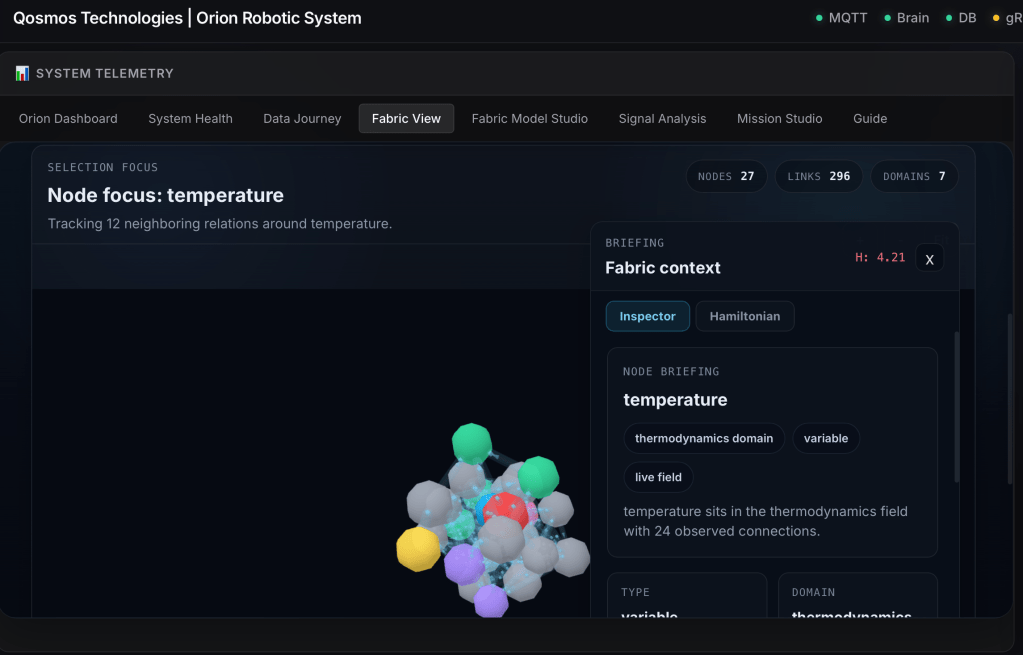
Learning Architecture
From embodied evidence to operational understanding.
Orion follows a disciplined loop that keeps discovery explicit, cumulative, and open to review.

Telemetry to Knowledge Flow
A live view of Orion’s end-to-end pipeline, where sensing, ingestion, cognitive processing, world-model updates, evolution requests, and federation remain visible in one operator surface.
Observe
Robots generate evidence through sensing, motion, mission execution, environmental response, and operator-supervised experimentation in the real world.
Model
Orion infers structure, evaluates candidate relationships, retains what survives scrutiny, and revises confidence as new evidence arrives.
Guide
That knowledge informs future missions, operator judgment, fabric protection, and the next cycle of discovery across the fleet.
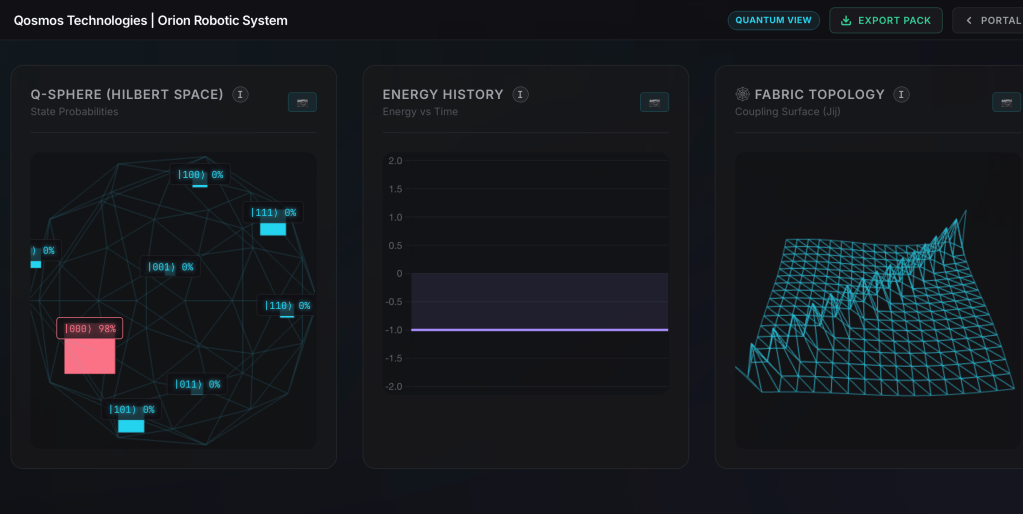
Causal Intelligence
A causal engine with quantum reach.
The Causal Engine
Orion is not simply a pattern archive. It is a causal discovery system. Its core engine evaluates how variables move together, how influence propagates across time, which candidate laws deserve confidence, and which beliefs should remain provisional. In Orion, contradiction and unexplained variance are signals that the model still has something to learn.
Quantum Algorithms
Orion extends this architecture with hybrid quantum-classical methods where they add value. Quantum optimization supports difficult combinatorial search. Quantum-enhanced structure proposals help surface hypothetical edges in the Fabric. Quantum kernels support high-dimensional anomaly analysis where conventional separations may be weak. When quantum backends are unavailable, the system degrades cleanly to classical paths.
Guided Discovery
An intelligence system that can identify what it still fails to explain.
Evolution Engine
The Evolution Engine gives Orion a higher-order reflex: the ability to ask what the system still fails to explain and which missing capability would reduce that ignorance. Persistent unexplained variance can be translated into structured Requests for Enhancement that identify the sensing, actuation, or software capability gap that would most improve learning.
This makes Orion more than adaptive. It becomes diagnostically self-aware in a practical sense, able to point toward the next capability, skill, or configuration change that would expand what the system can know. Open RFEs remain visible to operators as a governed improvement queue rather than an opaque self-modification path.
Purpose and Mission Studio
Orion is governed through intention. Its purpose layer allows teams to choose the stance of the system: observational, discovery-oriented, adversarial, or recursive. That matters because learning is not always passive. Sometimes the right next action is the one that reduces uncertainty most effectively.
Mission Studio turns that idea into an operator workflow. Teams describe intent in plain language, Orion resolves it into a mission contract, previews how the current world model will be used, shows fabric protection and approval requirements, then supports dispatch, live run status, and post-mission debrief.

RFE and Anomaly Workflow
A governed review surface where anomalies become structured RFEs, diagnostic context stays attached to each report, and approval remains explicit before proposed changes enter the improvement path.
Governance and Provenance
Learning stays inspectable because evidence, policy, and contribution remain attached to the model.
Sessions, Models, and Audit
Orion keeps operational history and curated understanding separate on purpose. Sessions preserve replayable context: telemetry, events, actions, and mission timelines. Fabric models preserve the current state of accepted and pending understanding. That separation makes it easier to trace how a belief was formed, which data contributed to it, and when a model should be promoted, revised, or rejected.
Operators can inspect provenance, review edge history, compare hypotheses with accepted relationships, and understand how the model changed over time instead of inheriting a black-box answer.
Policy, Protection, and Approval
Orion is not built around uncontrolled automation. Mission Studio previews how the current world model will be used, where protection rules apply, and which actions require approval before a run is dispatched. Fabric protection, mission review, and debrief close the loop between learning and governance.
The blockchain contribution ledger extends that trust model. Orion can sign and record robot contributions before they are integrated into shared knowledge, creating a durable chain of contribution and a stronger basis for provenance in environments where auditability matters.
Where The Model Becomes Operational
Operator surfaces that make learning actionable.
Analytical Surfaces
Review topology, anomalies, optimization history, and higher-order structure to understand where confidence is strong, where the model is weak, and what the system should investigate next.
Mission Studio and Fabric View
Describe mission intent in plain language, review Orion’s translation, confirm approval and fabric protection requirements, dispatch the run, then inspect the resulting world model with provenance and hypothesis history still intact.
Federation, Provenance, and Scale
Modular by design. Federated by knowledge.
Orion is built as a modular cognitive system. It can span embodied robots, edge intelligence, operator surfaces, and central theory-building without forcing all intelligence into one place. Different hardware tiers can contribute in different ways, and knowledge can be synchronized across separate brains and separate environments through federation.
That means scalability in Orion is not only about more devices or more telemetry. It is about a broader field of contribution: more embodiments generating experience, more contexts producing evidence, and more learning becoming transferable rather than local.
The federation model allows multiple Orion brains or deployment tiers to contribute to a shared fabric without collapsing all intelligence into one runtime. Contribution provenance stays attached as learning moves across robots and environments.
Taken together, modularity, federation, and ledger-backed provenance give Orion a strong posture for scaling learning across systems while keeping knowledge attributable, inspectable, and governable.
About Orion
Designed for systems that must learn without becoming opaque.
Orion is built on a simple premise: experience should not disappear into logs. It should mature into knowledge that remains available to the people and systems that depend on it.
It is not a promise of effortless autonomy and not a replacement for operators, safety boundaries, or engineering discipline. Orion is a framework for making robotic learning more legible, more cumulative, and more operationally useful.
For teams building advanced robotic systems, that means a stronger bridge between evidence and action: a way to let understanding deepen across deployments without losing transparency or control.
From raw telemetry to lasting intelligence, Orion makes robotic learning visible, cumulative, and usable.
Contact
Discuss Orion with Qosmos
For demos, pilot programs, or strategic conversations around Orion, contact us directly.
 Qosmos Technologies